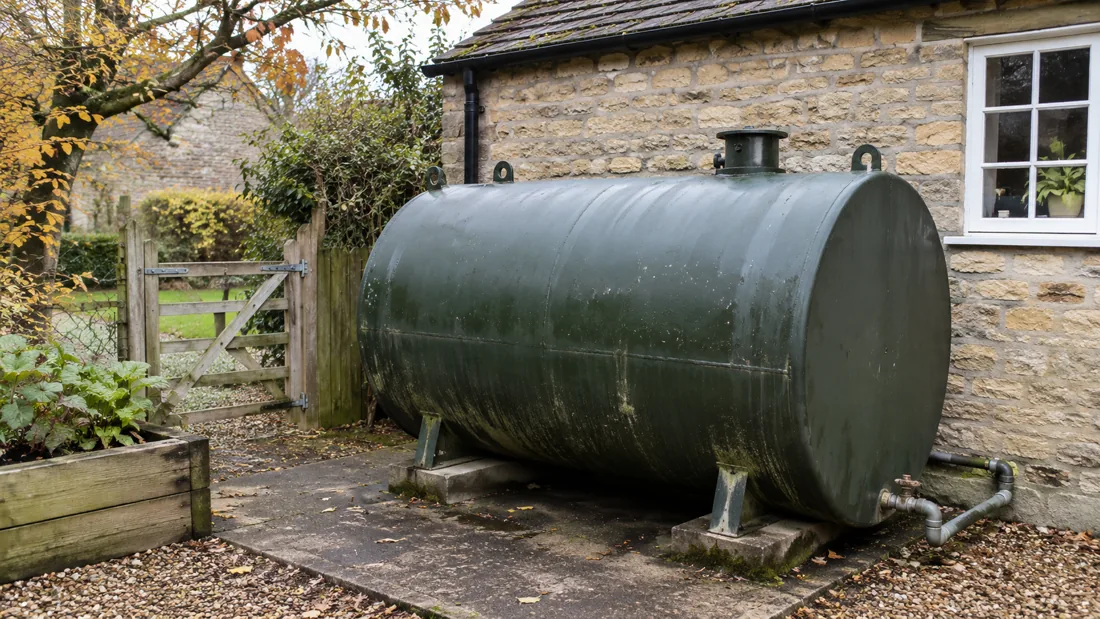
Remove, Replace Or Investigate First?
Choose removal when the tank has no continuing purpose, obstructs building work or is too damaged to retain. If the building still needs oil, compare a coordinated replacement before disconnecting anything. Removing the tank without a replacement supply can leave the property without heat or backup power.
A buried tank, unexplained oil loss or staining around the base needs further investigation. Removing the metal does not remove contamination already in the ground. Tell us about smells indoors, nearby drains and any earlier spill, even if the tank has been out of use for years.
The Removal Sequence
The contractor confirms the contents and isolation arrangements before pumping starts. Recoverable oil is separated from water and residue, then the tank is drained and cleaned. The lifting or dismantling method follows its material, condition and access route. Cutting is a specialist operation, never a shortcut around cleaning or atmospheric assessment.
On a commercial site, risk assessments and method statements set out isolation, exclusion areas and lifting arrangements. Where hot work is proposed, preparation and testing must address the fire and explosion risk. A description such as cold cutting is not, by itself, evidence that an unprepared tank is safe to cut.
What Happens To The Remaining Oil?
Please give an approximate level and the date of the last delivery. Usable oil may be transferred to a suitable receiving tank if its condition and available capacity allow. Water, sludge and degraded fuel need a separate route, which should be identified in the quotation.
Do not order a delivery simply to keep the tank in use until the appointment. Tell the supplier when the installation is being retired. If fuel will be kept on site temporarily, the receiving arrangement, secure position and later transfer should all be agreed before the removal begins.
Access Is Part Of The Method
A photograph from the road to the tank is often as useful as a close-up of the tank itself. Note gates, steps, sharp turns, covered passages, soft lawn and anything that cannot be disturbed. An empty tank can still be awkward to handle, and deteriorated material may not tolerate lifting whole.
For basements, yards and plant rooms, include doorway dimensions, headroom and the route for hoses. Confirm whether a vehicle can stand on private hardstanding and whether permits or booked access are needed. A lift over an obstacle requires its own assessment, rather than an assumption that a crane can reach.
What Changes The Removal Cost?
Volume and type of residue, fuel recovery, cleaning access and tank construction all affect the work. Whole-tank lifting, sectioning, restricted parking and carrying material through a building create different labour and equipment needs. Base demolition and reinstatement should be priced separately if required.
For buried storage, excavation, service searches, ground conditions and contaminated material can dominate the scope. Ask which assumptions the price relies on and what would trigger an additional quotation. Photographs can support an initial estimate, but uncertainty about contents or concealed connections may require a survey.
Records At Completion
Agree the record of removal and disposal before booking. Waste documentation depends on the classification of each waste stream and the journey involved. Ask for the relevant transfer or hazardous waste consignment documentation, rather than a promise that every item receives the same certificate.
Commercial handover may also include isolation records, lifting information and evidence of any atmosphere testing or hot-work preparation. HSE confined-space guidance is relevant where access creates confined-space risks. Keep the completion documents with property records, especially where future purchasers may ask what happened to a former fuel system.
Common Questions
Can A Tank Be Removed Through A Narrow Gate?
Oil tank removal through a narrow gate may be possible after professional preparation and controlled dismantling. The method depends on material, condition, residues and the route out. Send gate widths and photographs of any turns or steps so the contractor can judge whether sectioning, lifting or another access arrangement is suitable.
Does Removal Include The Concrete Base?
Oil tank removal does not automatically include breaking out a concrete base. A base may be retained, removed or adapted for a new use, depending on the agreed scope. Ask for demolition, disposal of rubble and making good to be listed separately so the final ground finish is clear.
Tell Us About Your Tank
A postcode, photographs of the installation and an outline of the access are a useful starting point. Mention any suspected leak at the start of your enquiry.
Send A Tank Enquiry